Fleming took the name for his character from that of the American
ornithologist James Bond, a
Caribbean bird expert and author of the definitive
field guide Birds of the West Indies; Fleming, a keen
birdwatcher himself, had a copy of Bond's guide and he later explained to the ornithologist’s wife that "It struck me that this brief, unromantic, Anglo-Saxon and yet very masculine name was just what I needed, and so a second James Bond was born". He further explained that:
When I wrote the first one in 1953, I wanted Bond to be an extremely dull, uninteresting man to whom things happened; I wanted him to be a blunt instrument...when I was casting around for a name for my protagonist I thought by God, (James Bond) is the dullest name I ever heard.
On another occasion Fleming said: "I wanted the simplest, dullest, plainest-sounding name I could find, "James Bond" was much better than something more interesting, like "Peregrine Carruthers". Exotic things would happen to and around him, but he would be a neutral figure—an anonymous, blunt instrument wielded by a government department."
- Inspiration
Fleming based his fictional creation on a number of individuals he came across during his time in the
Naval Intelligence Division during
World War II, admitting that Bond "was a compound of all the secret agents and commando types I met during the war".
[4] Amongst those types were his brother,
Peter, who had been involved in behind the lines operations in Norway and Greece during the war.
[5] Aside from Fleming's brother, a number of others also provided some aspects of Bond's make up, including
Conrad O'Brien-ffrench,
Patrick Dalzel-Job and
Bill "Biffy" Dunderdale.
[4]
- Tastes
Fleming also endowed Bond with many of his own traits, including sharing the same golf handicap, the taste for scrambled eggs and using the same brand of toiletries. Bond's tastes are also often taken from Fleming’s own as was his behaviour,
[7] with Bond's love of golf and gambling mirroring Fleming's own. Fleming used his experiences of his espionage career and all other aspects of his life as inspiration when writing, including using names of school friends, acquaintances, relatives and lovers throughout his books.
[4]
- Looks
Fleming decided Bond should look a little like both the American singer
Hoagy Carmichael and himself and in
Casino Royale,
Vesper Lynd remarks, "Bond reminds me rather of Hoagy Carmichael, but there is something cold and ruthless." Likewise, in
Moonraker,
Special Branch Officer
Gala Brand thinks that Bond is "certainly good-looking… Rather like Hoagy Carmichael in a way. That black hair falling down over the right eyebrow. Much the same bones. But there was something a bit cruel in the mouth, and the eyes were cold."
- Background
It was not until the penultimate novel,
You Only Live Twice, that Fleming gave Bond a sense of family background. The book was the first to be written after the release of
Dr. No in cinemas and
Sean Connery's depiction of Bond affected Fleming's interpretation of the character, to give Bond both a sense of humour and Scottish antecedents that were not present in the previous stories. In a fictional obituary, purportedly published in
The Times, Bond's parents were given as Andrew Bond, from the village of
Glencoe,
Scotland, and Monique Delacroix, from
Yverdon,
Switzerland. Fleming did not provide Bond's date of birth, but
John Pearson's fictional biography of Bond,
James Bond: The Authorised Biography of 007, gives Bond a birth date on 11 November 1920, whilst a study by John Griswold puts the date at 11 November 1921.
Novels and related works
Ian Fleming novels
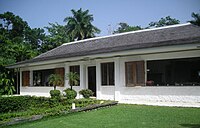
Goldeneye, in Jamaica, where Fleming wrote all the Bond novels.
Whilst serving in the Naval Intelligence Division, Fleming had planned to become an author
[14] and had told a friend, "I am going to write the spy story to end all spy stories."
[4] On 17 February 1952, he began writing his first James Bond novel,
Casino Royale at his
Goldeneye estate in Jamaica, where he wrote all his Bond novels, during the months of January and February each year. He started the story shortly before his wedding to his pregnant girlfriend, Ann Charteris, in order to distract himself from his forthcoming nuptials.
After completing the manuscript for
Casino Royale, Fleming showed the manuscript to his friend (and later editor)
William Plomer to read. Plomer liked it and submitted it to the publishers,
Jonathan Cape, who did not like it as much. Cape finally published it in 1953 on the recommendation of Fleming's older brother
Peter, an established travel writer. Between 1953 and 1966, two years after his death, twelve novels and two short-story collections were published, with the last two books –
The Man with the Golden Gun and
Octopussy and The Living Daylights – published posthumously. All the books were published in the UK through Jonathan Cape.
Post-Fleming novels
After Fleming's death a continuation novel,
Colonel Sun, was written by
Kingsley Amis (as
Robert Markham) and published in 1968.
[33] Amis had already written a literary study of Fleming's Bond novels in his 1965 work
The James Bond Dossier. Although
novelizations of two of the
Eon Productions Bond films appeared in print,
James Bond, The Spy Who Loved Me and
James Bond and Moonraker, both written by screenwriter
Christopher Wood,
[35] the series of novels did not continue until the 1980s. In 1981, thriller writer
John Gardner picked up the series with
Licence Renewed. Gardner went on to write sixteen Bond books in total; two of the books he wrote –
Licence to Kill and
GoldenEye – were novelizations of Eon Productions films of the same name. Gardner moved the Bond series into the 1980s, although he retained the ages of the characters as they were when Fleming had left them. In 1996, Gardner retired from writing James Bond books due to ill health.
[38]


